Researchers spend 80% of their time fundraising instead of conducting actual research
Traditional grants can take years to secure, delaying breakthroughs that could affect millions. This is known as the research valley of death.
Molecule aims to solve this through decentralized crowdfunding, allowing crypto-native supporters to fund research in exchange for tokens that grant voting rights on decisions such as licensing and revenue distribution.
In 2024, I led the design of Catalyst, a crowdfunding platform that raised over $2M for seven research projects, including Alzheimer’s research.
The challenge was to design a crowdfunding platform simple enough for researchers while attracting crypto-native users
Researchers had limited time and experience creating crowdfunding campaigns, while backers needed enough information and confidence to support complex scientific projects.
We also needed to meet legal requirements around tokenization, which required licensing intellectual property from researchers’ universities. A process that could take weeks.
We aligned four stakeholders around a new funding model with a user journey map
The fundraise required carefully sequenced collaboration between researchers, universities, backers, and Molecule. Working with protocol engineers and IP lawyers, I mapped how key stakeholders would interact through the fundraise, making dependencies explicit and aligning the team before we committed to a solution.
Mapping the flow exposed the assumptions we needed to test. Could researchers provide compelling project materials? Would backers be interested? How would they get answers about the research?
A shared framework helped us prioritize and prototype the highest-value ideas
I led brainstorming sessions to turn those questions into testable hypotheses. We scored each one by impact, confidence, and ease, giving different members of the team a structured way to contribute their expertise and helping us prioritize based on value rather than instinct.
Initial ideas included a project-creation flow for researchers and integrated chat between researchers and backers. We prototyped the highest-priority ideas and tested them with users.
Testing showed where software helped, and where it didn’t
Researchers lacked the time and expertise to prepare compelling project materials. Backers liked the integrated chat, but researchers had little time to engage with them. Backers were also concerned about waiting several weeks for IP acquisition and tokenization.
Rather than building more features around those problems, we changed the operating model and focused on communicating clear fundraising states to backers.
We replaced product complexity with hands-on support
For researchers, we introduced a white-glove project creation service using Molecule’s internal resources, allowing us to learn firsthand how to communicate dense scientific projects to backers. We also replaced integrated chat with Discord, allowing Molecule to field questions on behalf of researchers.
Clear fundraising states reduced uncertainty during IP acquisition
I designed clear fundraising states, including a negotiating state that showed the progress of IP acquisition and gave backers access to Discord for follow-up questions.
The final MVP focused on the ideas we had evidence for and avoided building features that depended on researcher time.
The existing brand felt too clinical for the audience we needed to reach
Stakeholder interviews showed that Molecule’s existing brand felt too clinical for crypto-native backers, while a UI audit exposed issues with hierarchy, contrast, and accessibility.
The challenge was to make the product feel more native to crypto communities without losing the scientific credibility researchers expected.
We built a visual system that balanced scientific credibility with crypto-native cues
I introduced a darker, more expressive palette while maintaining contrast and accessibility requirements. I also built a component library and design guidelines to keep the experience consistent as the product expanded.
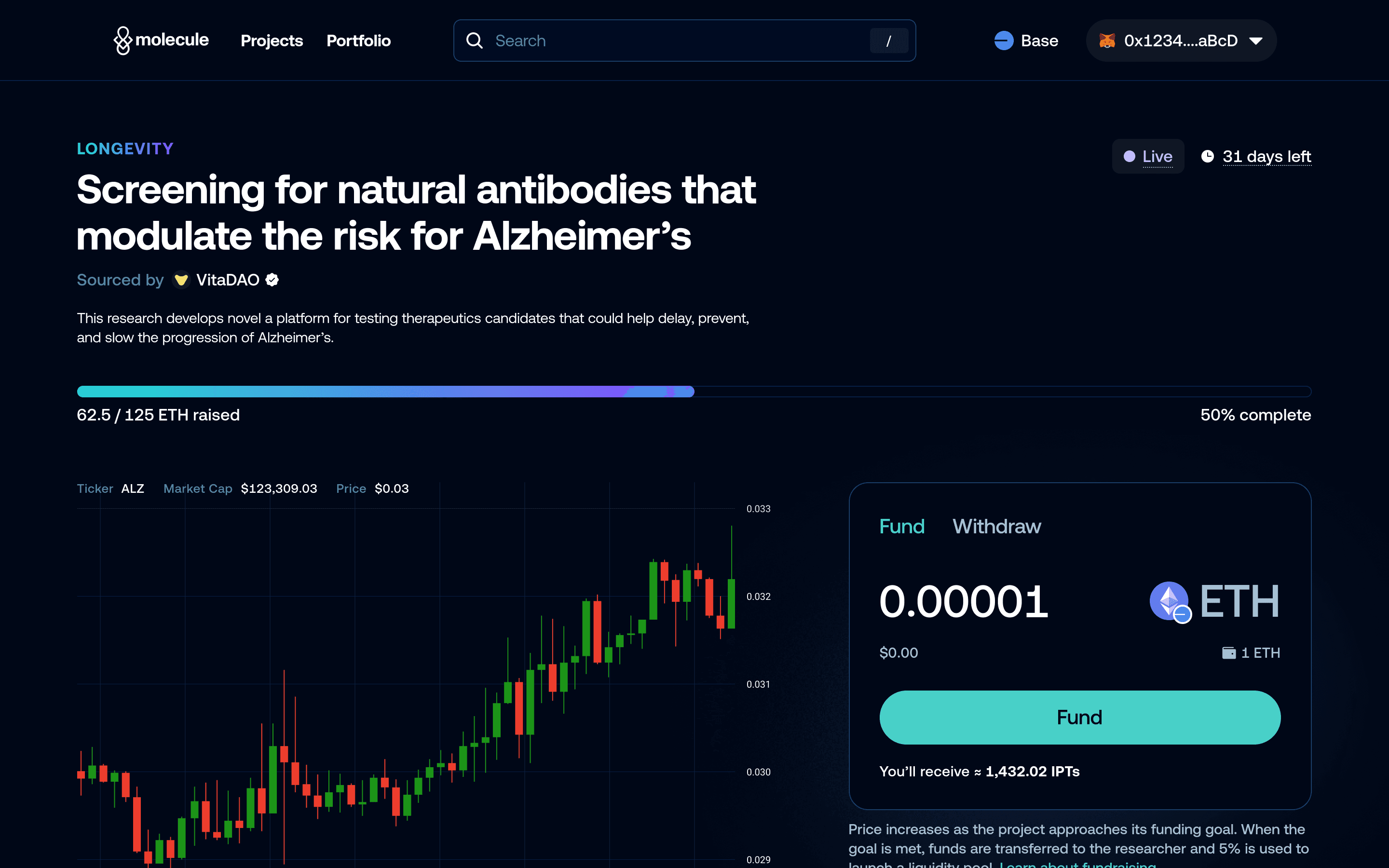
The final MVP combined project information, funding progress, and the updated visual system in a single responsive experience.

Catalyst raised over $2M across seven research projects
In its first 30 days, Catalyst raised 76 ETH, worth $250,000, for Project Transfidelity.
Led by Dr. Dimitri Scherbakov and Dr. Rashid Akbergenov, the project is investigating the root causes of dementia and Alzheimer’s disease.
Catalyst went on to raise funds for six additional projects over the next three months, bringing the total raised to over $2M.
Raz was crucial to the success of Catalyst from end-to-end. More than just a product designer, his process-driven approach, strategic thinking, and ability to navigate complexity set him apart.