An alternative funding model for overlooked scientific research through BioDAOs
Critical areas of scientific research, like women’s health, remain underfunded due to research biases and fragmented financing.
Bio.xyz is building an alternative funding model through BioDAOs: community-governed organizations that use blockchain to fund and develop early-stage biotech and medical research. BioDAOs go through Bio.xyz’s 18-week accelerator, which culminates in a community token sale to fund their research.
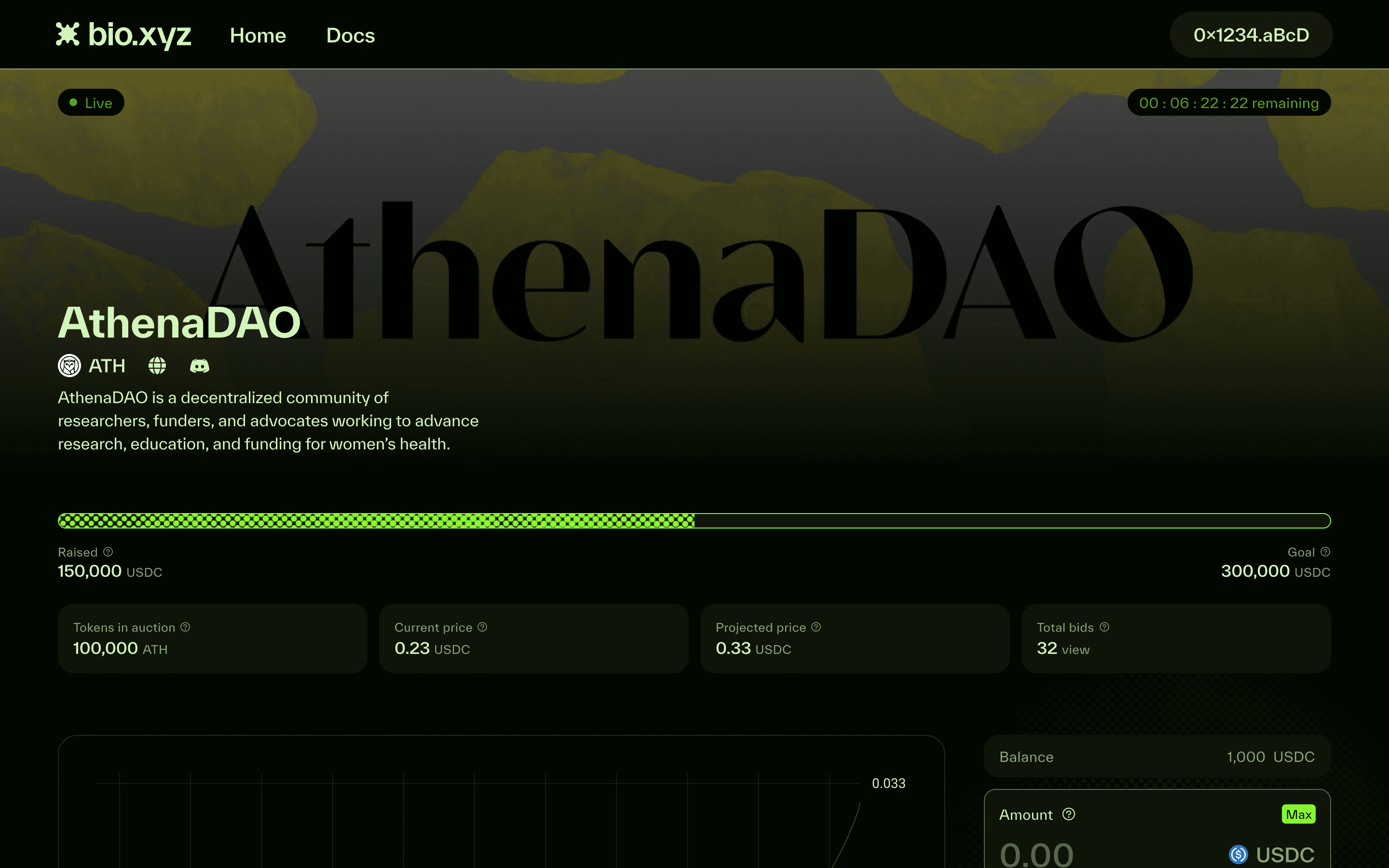
In 2023, I led the design of Bio.xyz’s token launchpad in an eight-week sprint. The first two BioDAO launches raised more than $3 million for women’s health and brain health research.
The challenge was to turn a token sale into the start of an active community in 8 weeks
For BioDAOs, a token auction wasn’t only about raising funds, it was about building a community of informed and active participants. Before the auction, BioDAOs needed to build awareness. During the sale, users needed clear guidance on how to participate. After the auction, token holders needed to understand what came next. The challenge was to design a launchpad that fit into the broader context of funding and accelerating scientific advancement.
An existing auction protocol let us bootstrap the launchpad and focus on the participant experience
With eight weeks to our first launch, we needed to bootstrap the product. We decided to build the Launchpad on the Gnosis Auctions protocol because its fair price-discovery mechanism aligned with our goal of maximizing participation. This choice defined the underlying auction mechanics and the core information the interface needed to support.
I tested the existing Gnosis interface with users to understand which elements mattered and which added noise. Detailed auction parameters cluttered the top half of the interface, and related information, such as the minimum bid amount and the bid input field, was scattered.
The findings informed a redesign centered on participant decisions. Related information moved closer together, technical details became secondary, and the hierarchy emphasized what users needed to know and do before placing a bid.
A shared participant journey and design principles aligned the team around the experience
Working with our UX researcher, BioDAOs, the legal team, and developers, I helped consolidate our research into user journeys and design principles. The journey mapped the experience from pre-launch through post-auction participation, bringing goals, pain points, and opportunities together into one view. Design principles guided our approach in everything we did, from information hierarchy down to individual interactions and components.
We tested different ways to help participants price their bids
Simplifying the interface addressed only part of the issue. Participants also struggled to choose a bid price and judge whether it was likely to succeed.
I explored different levels of guidance, including suggested prices, automatic pricing, and a bid-strength indicator. The challenge was to help participants make a better-informed bid without pushing them toward a particular price.
The final design paired a strength meter with optional auto pricing. As participants adjusted their price, the meter updated to show how competitive the bid was, and those who wanted more guidance could let the system set the price automatically.
We mapped where wallet funding and KYC should enter the bid flow
Creating and funding a wallet was a major friction point for many participants, and my goal was to keep the path to placing a bid as short as possible. We also needed to introduce identity verification for large bids, which added to the challenge.
Mapping the full bid flow helped decide where each requirement should appear and which steps could stay conditional. The aim was to keep unnecessary friction out of the default path.
The final solution let users connect an existing wallet or create a new one, while the onramp appeared only when their balance fell below the minimum bid amount. KYC followed the same principle, appearing only when a bid crossed the 1,000 USDC threshold.
A shared state model kept participants oriented throughout the auction
To make the auction feel like one continuous journey, I needed to understand what participants needed at each stage of the sale.
I worked with developers to map the underlying auction states, and with BioDAOs and users to understand the goals, questions, and actions associated with each stage.
That state model became the framework for designing hierarchy, actions, messaging, and notifications around what participants needed to do next.
In preview, the focus was on learning about the sale and getting ready to participate. During the auction, bidding and bid status became primary. Once it closed, the experience shifted to results, claiming, and ways for token holders to stay involved with the BioDAO.
Trust depended on understanding both the auction and the people behind it
A successful auction meant building trust, and participants needed transparency on the auction mechanics. More importantly, they needed to understand who was behind the auction and what they were supporting before committing funds.
I designed an auction launch flow that let BioDAOs add brand assets, team details, and social links so participants could see who was behind the project.
FAQs, auction pricing information, and token holder benefits gave participants more context before bidding, while links to community channels gave them a place to ask questions directly.
The first two BioDAO launches raised more than $3M for scientific research
The final launchpad brought these decisions together into one responsive experience, from discovering an upcoming auction and preparing to bid through claiming an allocation and joining the BioDAO community afterward.
We launched the MVP product in eight weeks. The first two BioDAO launches raised more than $3 million for women’s health and brain health research. Beyond the individual auctions, the project established a reusable launchpad for bringing future BioDAOs from accelerator to community token sale.